abacus
abacus
13 Apr 2026 • 5 min read
13 Apr 2026 • 5 min read
The Android POS Advantage Most Restaurant Operators Miss
The Android POS Advantage Most Restaurant Operators Miss
The Android POS Advantage Most Restaurant Operators Miss
Most restaurants look at Android POS and see lower hardware costs. The real advantage runs deeper. This piece breaks down why Android is emerging as the operating system for modern hospitality.
Most restaurants look at Android POS and see lower hardware costs. The real advantage runs deeper. This piece breaks down why Android is emerging as the operating system for modern hospitality.
Written by

Liven
The ultimate hospo solution
Ask most restaurant operators why they're considering an Android POS system and you'll hear the same answer: "It's cheaper." That's true. But there’s a larger strategic shift happening underneath.
The real shift to Android isn’t just about saving on hardware. It’s about moving to a platform that actually fits how modern hospitality operates. Android has become the Operating System (OS) of choice for serious hospitality technology globally and in Australia. Here's a breakdown of why.
A New Generation of POS
iPads became the rage in the 2010s, when they began replacing clunky Windows devices. They looked better, felt modern and were reliable. But they were never built for hospitality. They were built for consumers, and have been bent into commercial use ever since. Now the cracks are harder to ignore. Updates depend on App Store approvals, connectivity relies on adapters and certified accessories and hardware is fixed, not purpose-built.
On the other end, Windows systems are hitting a different wall altogether. Windows 10 reached end of life in October 2025. Microsoft no longer provides security patches, feature updates, or technical support. That’s a real risk tied to payments, data, and uptime.
Here are the many ways an Android POS like Liven Abacus POS wins over other platforms.
#1 Connectivity without workarounds
iPad POS setups are designed for simplicity, but that comes with constraints. Limited ports mean you often rely on adapters, wireless connections, or certified accessories to connect peripherals like printers or EFTPOS.
Android POS systems give you more direct hardware access. Support for Ethernet, USB, and serial connections makes it easier to run stable, wired setups, especially when multiple devices need to work together.
Why that matters in practice:
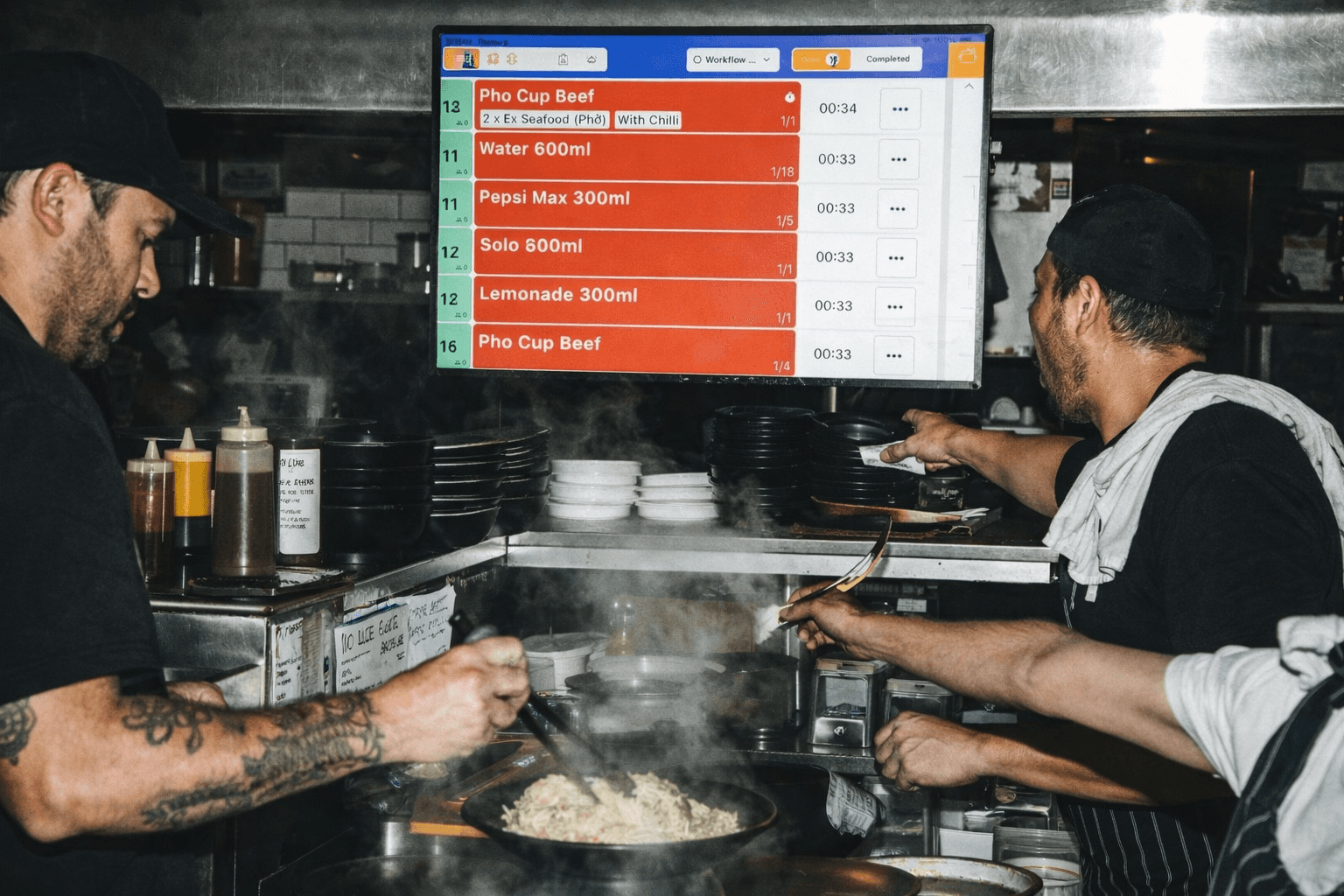
Kitchen displays stay connected during peak (wired > Wi-Fi)
EFTPOS integrations like Tyro work more reliably with stable connections
Multi-device environments (printers, cash drawers, KDS) are simpler to set up and maintain
In fact, Liven Abacus Android POS systems have a true offline mode that ensures that service keeps moving smoothly even if there is no network connectivity.
#2 Hardware that’s built for real service environments:
An iPad in a kiosk is still an iPad in a case. Android gives you purpose-built hospitality hardware:
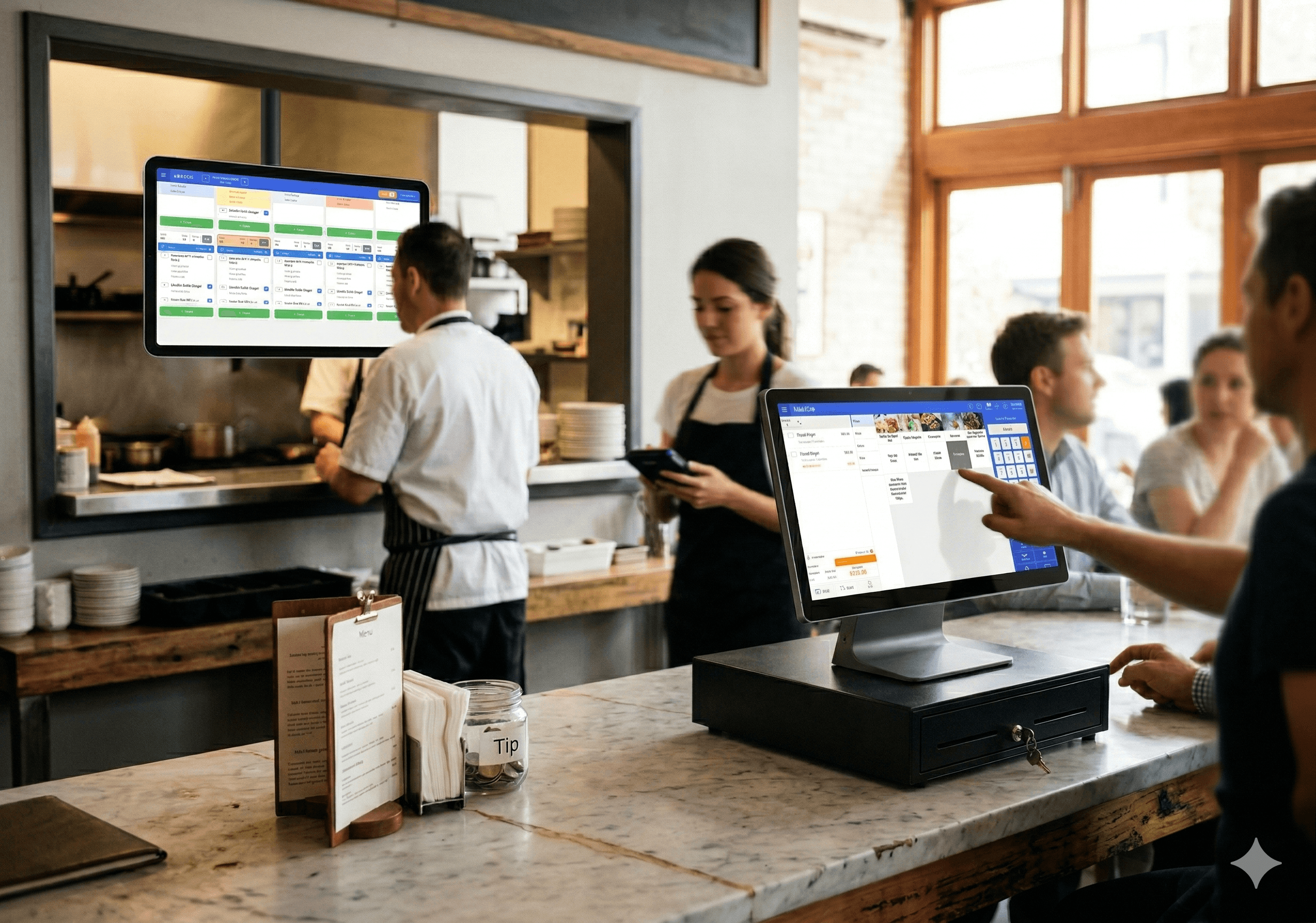
Large, properly mounted kitchen display systems
Fully secure kiosks
All-in-one handhelds for ordering and payments
These devices are designed for the job with features such as splash-resistance for kitchens and drop-resistance for floor staff. Plus you get a range of form factors that fit into your venue.
Versatile Android hardware changes how service actually happens. Staff can take orders tableside, process payments instantly, and operate anywhere. In fact, with Liven Mobile POS systems, staff can even print receipts or read reports on the go. This means faster throughput, shorter wait times and higher staff efficiency. In a high labour-cost market like Australia, that’s margin.
#3 Familiar Interface = Less training, fewer errors:
Staff turnover is a constant in hospitality, and the faster new hires can get comfortable with your POS, the better.
Modern POS systems can reduce onboarding time by aligning the interface with real service workflows: things like order flows, table layouts, and modifier logic. When the system mirrors how your venue actually operates, staff spend less time learning the tool and more time learning the menu and service standards.
Android-based POS systems often provide more flexibility in how these workflows and the interface can be configured, particularly in setups that combine multiple devices and service modes. That said, usability ultimately depends on the POS software itself, not just the operating system.
So the advantage comes from how well the system fits your operation, not the platform alone. When that fit is right, teams make fewer errors and get up to speed faster, even during peak service.
#4 Scaling that doesn’t need rebuilding
One of the most quietly significant advantages of Android as a platform is what it does to your cost curve as you grow.
Opening a new venue doesn't require a fresh capital commitment to proprietary hardware as you can run Android OS on Windows hardware. Updating your menu or pricing doesn't require a site visit from a technician, saving costs and reducing downtime. Adding new features doesn’t need custom development or additional tooling. And a new venue doesn’t mean building from scratch.
So, instead of “New store = new setup”, you get: “New store = same system, deployed faster”
The marginal cost of growing falls, which means your unit economics get better as you scale rather than worse. For a group operator looking at five, ten, or twenty venues, this compound effect is substantial. In fact, operators using Liven see their total cost of ownership (TCO) come down by as much as 75%.
#5 Built for what’s coming next
Android gives operators access to new capabilities as they emerge, without needing entirely new hardware or system overhauls. Instead of being locked into today’s setup, you’re able to adopt new capabilities as they become available, without rebuilding your stack each time.
For example, features like Tap to Glass, enabled by Android-OS based hardware allow contactless payments to be accepted directly on the device, removing the need for separate EFTPOS terminals. That reduces hardware overhead, simplifies operations, and opens up more flexible service models, from queue-busting to fully mobile checkout.
At the same time, lower hardware costs change what’s viable inside the venue. Operators can deploy customer-facing displays (CFDs) or additional ordering points in places where the ROI previously didn’t justify the investment.
That means more surfaces to drive upsells, improve order accuracy, and capture revenue, without a significant increase in upfront cost.
Who You Move With Matters As Much As The Move Itself
The Android ecosystem's openness is its greatest strength, but it means the quality of implementation varies wildly. The right partner brings three things.
Deep hospitality expertise: understanding that a restaurant operates differently at 7pm on a Saturday than at 10am on a Tuesday, and that your technology needs to flex accordingly.
Genuine integration capability: the ability to connect your POS, ordering channels, kitchen operations, payments, and customer data into a coherent whole rather than a looser collection of Android apps.
A long-term stake in your success: not just selling you hardware, but invested in what your numbers look like twelve months after go-live.
Liven has spent years building exactly this: a full-stack hospitality platform, built native on Android, serving over 35,000 venues across Australia and Asia. The platform handles Android POS, kitchen display systems, digital ordering, kiosks, payments, supply and inventory management, loyalty, and marketing automation, all unified, all talking to each other, all running on Australia's #1 operating system for hospitality. In practical terms, this means your:
POS integrates natively Nomnie Pay and leading payments providers.
Kitchen display receives orders from every channel (in-venue, kiosk, digital ordering, catering) without a third-party aggregator sitting in the middle adding latency and cost
Supply and inventory system pulls directly from your sales data
Menu changes made at head office sync to every venue, every channel, every screen
Data from across your business is visible in one place
The Android advantage is real. Most operators only see part of it. We'd like to show you the rest.
Talk to the team about what an Android-native stack looks like for your venues.
Ask most restaurant operators why they're considering an Android POS system and you'll hear the same answer: "It's cheaper." That's true. But there’s a larger strategic shift happening underneath.
The real shift to Android isn’t just about saving on hardware. It’s about moving to a platform that actually fits how modern hospitality operates. Android has become the Operating System (OS) of choice for serious hospitality technology globally and in Australia. Here's a breakdown of why.
A New Generation of POS
iPads became the rage in the 2010s, when they began replacing clunky Windows devices. They looked better, felt modern and were reliable. But they were never built for hospitality. They were built for consumers, and have been bent into commercial use ever since. Now the cracks are harder to ignore. Updates depend on App Store approvals, connectivity relies on adapters and certified accessories and hardware is fixed, not purpose-built.
On the other end, Windows systems are hitting a different wall altogether. Windows 10 reached end of life in October 2025. Microsoft no longer provides security patches, feature updates, or technical support. That’s a real risk tied to payments, data, and uptime.
Here are the many ways an Android POS like Liven Abacus POS wins over other platforms.
#1 Connectivity without workarounds
iPad POS setups are designed for simplicity, but that comes with constraints. Limited ports mean you often rely on adapters, wireless connections, or certified accessories to connect peripherals like printers or EFTPOS.
Android POS systems give you more direct hardware access. Support for Ethernet, USB, and serial connections makes it easier to run stable, wired setups, especially when multiple devices need to work together.
Why that matters in practice:
Kitchen displays stay connected during peak (wired > Wi-Fi)
EFTPOS integrations like Tyro work more reliably with stable connections
Multi-device environments (printers, cash drawers, KDS) are simpler to set up and maintain
In fact, Liven Abacus Android POS systems have a true offline mode that ensures that service keeps moving smoothly even if there is no network connectivity.
#2 Hardware that’s built for real service environments:
An iPad in a kiosk is still an iPad in a case. Android gives you purpose-built hospitality hardware:
Large, properly mounted kitchen display systems
Fully secure kiosks
All-in-one handhelds for ordering and payments
These devices are designed for the job with features such as splash-resistance for kitchens and drop-resistance for floor staff. Plus you get a range of form factors that fit into your venue.
Versatile Android hardware changes how service actually happens. Staff can take orders tableside, process payments instantly, and operate anywhere. In fact, with Liven Mobile POS systems, staff can even print receipts or read reports on the go. This means faster throughput, shorter wait times and higher staff efficiency. In a high labour-cost market like Australia, that’s margin.
#3 Familiar Interface = Less training, fewer errors:
Staff turnover is a constant in hospitality, and the faster new hires can get comfortable with your POS, the better.
Modern POS systems can reduce onboarding time by aligning the interface with real service workflows: things like order flows, table layouts, and modifier logic. When the system mirrors how your venue actually operates, staff spend less time learning the tool and more time learning the menu and service standards.
Android-based POS systems often provide more flexibility in how these workflows and the interface can be configured, particularly in setups that combine multiple devices and service modes. That said, usability ultimately depends on the POS software itself, not just the operating system.
So the advantage comes from how well the system fits your operation, not the platform alone. When that fit is right, teams make fewer errors and get up to speed faster, even during peak service.
#4 Scaling that doesn’t need rebuilding
One of the most quietly significant advantages of Android as a platform is what it does to your cost curve as you grow.
Opening a new venue doesn't require a fresh capital commitment to proprietary hardware as you can run Android OS on Windows hardware. Updating your menu or pricing doesn't require a site visit from a technician, saving costs and reducing downtime. Adding new features doesn’t need custom development or additional tooling. And a new venue doesn’t mean building from scratch.
So, instead of “New store = new setup”, you get: “New store = same system, deployed faster”
The marginal cost of growing falls, which means your unit economics get better as you scale rather than worse. For a group operator looking at five, ten, or twenty venues, this compound effect is substantial. In fact, operators using Liven see their total cost of ownership (TCO) come down by as much as 75%.
#5 Built for what’s coming next
Android gives operators access to new capabilities as they emerge, without needing entirely new hardware or system overhauls. Instead of being locked into today’s setup, you’re able to adopt new capabilities as they become available, without rebuilding your stack each time.
For example, features like Tap to Glass, enabled by Android-OS based hardware allow contactless payments to be accepted directly on the device, removing the need for separate EFTPOS terminals. That reduces hardware overhead, simplifies operations, and opens up more flexible service models, from queue-busting to fully mobile checkout.
At the same time, lower hardware costs change what’s viable inside the venue. Operators can deploy customer-facing displays (CFDs) or additional ordering points in places where the ROI previously didn’t justify the investment.
That means more surfaces to drive upsells, improve order accuracy, and capture revenue, without a significant increase in upfront cost.
Who You Move With Matters As Much As The Move Itself
The Android ecosystem's openness is its greatest strength, but it means the quality of implementation varies wildly. The right partner brings three things.
Deep hospitality expertise: understanding that a restaurant operates differently at 7pm on a Saturday than at 10am on a Tuesday, and that your technology needs to flex accordingly.
Genuine integration capability: the ability to connect your POS, ordering channels, kitchen operations, payments, and customer data into a coherent whole rather than a looser collection of Android apps.
A long-term stake in your success: not just selling you hardware, but invested in what your numbers look like twelve months after go-live.
Liven has spent years building exactly this: a full-stack hospitality platform, built native on Android, serving over 35,000 venues across Australia and Asia. The platform handles Android POS, kitchen display systems, digital ordering, kiosks, payments, supply and inventory management, loyalty, and marketing automation, all unified, all talking to each other, all running on Australia's #1 operating system for hospitality. In practical terms, this means your:
POS integrates natively Nomnie Pay and leading payments providers.
Kitchen display receives orders from every channel (in-venue, kiosk, digital ordering, catering) without a third-party aggregator sitting in the middle adding latency and cost
Supply and inventory system pulls directly from your sales data
Menu changes made at head office sync to every venue, every channel, every screen
Data from across your business is visible in one place
The Android advantage is real. Most operators only see part of it. We'd like to show you the rest.
Talk to the team about what an Android-native stack looks like for your venues.
Liven is the first complete hospitality system that works for you. Loved by over 7,000 venues across Asia Pacific and used by tens of millions of diners and operators annually. To see how Liven can work for you, visit liven.love
Liven is the first complete hospitality system that works for you. Loved by over 7,000 venues across Asia Pacific and used by tens of millions of diners and operators annually. To see how Liven can work for you, visit liven.love
Share this post
Share this post
You might also like
You might also like
You might also like
Browse by category
Browse by category
End not knowing!
Get industry insights, guides, best practices from the best operators, sneak previews of new technology, and more!
End not knowing!
Get industry insights, guides, best practices from the best operators, sneak previews of new technology, and more!
End not knowing!
Get industry insights, guides, best practices from the best operators, sneak previews of new technology, and more!